
Streamlined Cardiac CT
Rapid, coordinated access to cardiac CT and specialist review for your patients, across South East Queensland.
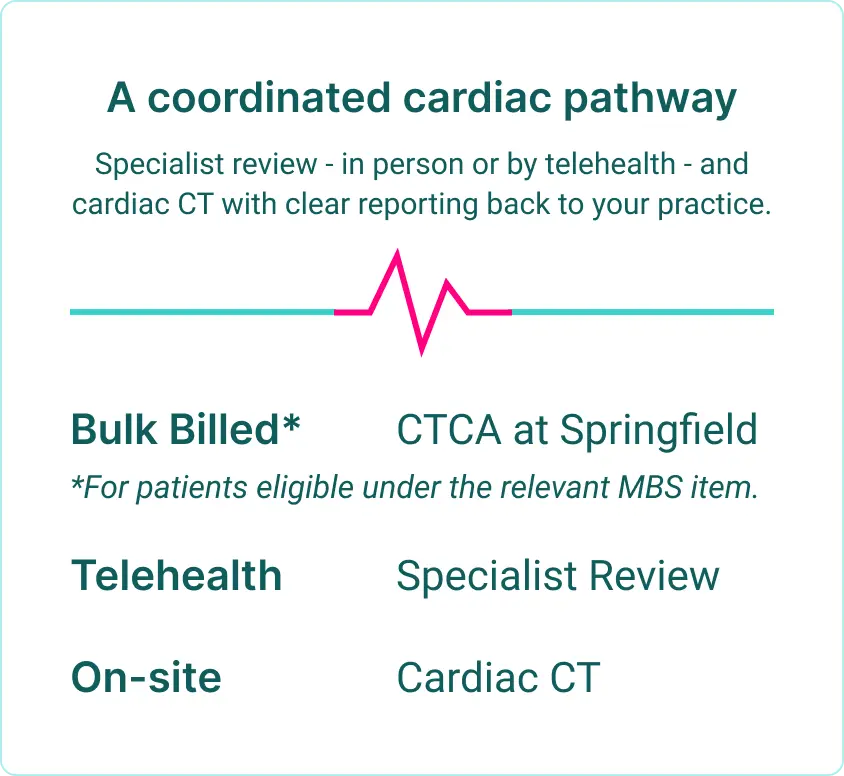
A COORDINATED APPROACH
Integrated cardiac care for patients and referrers
SmartCare Diagnostics provides cardiac imaging designed to work for both patients and referring doctors. Our streamlined cardiac CT pathways combine specialist review, in person or by telehealth, with the diagnostic capability of cardiac CT, giving clinically appropriate patients timely access to cardiovascular assessment and clear reporting back to your practice.
How the streamlined pathway works
1.
GP Referral
Submit a referral for Cardiac CT or specialist review.
2.
Specialist Review
Reviewed by one of our specialists, in person or by telehealth.
3.
Cardiac CT
Where indicated, patients proceed directly to CTCA or CAC scoring, with CTCA scanned on-site at Springfield.
4.
Report to GP
Findings return to the referring practice for ongoing management.
REDUCING DIAGNOSTIC DELAY
Shorter time to cardiac assessment
With our streamlined pathways, clinically appropriate patients access specialist review, in person or by telehealth, and, where indicated, proceed to cardiac CT scanned on-site at Springfield. This shortens the diagnostic pathway, supports specialist-informed management, and maintains continuity of care with the referring practice.
CLINICAL GUIDANCE - When to refer for Cardiac CT
Symptomatic Patients
CT Coronary Angiogram (CTCA)
For symptomatic patients, CTCA provides the information of a calcium score and identifies the degree of coronary stenosis caused by calcified or non-calcified plaque — a known cause of most myocardial infarctions.
In patients with stable symptoms suggestive of coronary artery disease (for example, stable chest pain, shortness of breath, or fatigue) without previously documented CAD, CTCA is often the preferred first-line investigation.
Asymptomatic Patients
Coronary Artery Calcium (CAC) score
For asymptomatic patients, a calcium score — alongside clinical risk assessment — can improve precision in cardiovascular event risk prediction and help guide pharmacological treatment decisions.
The score reflects the amount of calcified plaque in the coronary arteries and can reclassify a patient's risk up or down, consistent with the Australian Cardiovascular Disease Risk Calculator. Any non-zero score indicates calcified atherosclerosis. Results are reported as an absolute value with an age-, sex- and ethnicity-adjusted percentile.
REFERENCE
CAC score risk classification
The Cardiac Society of Australia and New Zealand (CSANZ) classifies calcium scores into categories associated with cardiovascular risk.
0
Very Low Risk
Risk of myocardial infarction / stroke at 10 years <1%
1-100
Low Risk
Risk of myocardial infarction / stroke at 10 years <10%
101-400
Moderate Risk
Risk of myocardial infarction / stroke at 10 years 10-20%
101-400 >75%
Moderate High Risk
Risk of myocardial infarction / stroke at 10 years 15-20%
400 >
High Risk
Risk of myocardial infarction / stroke at 10 years >20%
Adapted from the Australian Journal of general Practice (RACGP), August 2020. RIsk categories per CSANZ. Percentiles referenced against the Australian Cardiovascular Disease Risk Calculator.
Refer a patient for cardiac CT
CAC or CTCA - complete the referral form or contact our bookings team.