
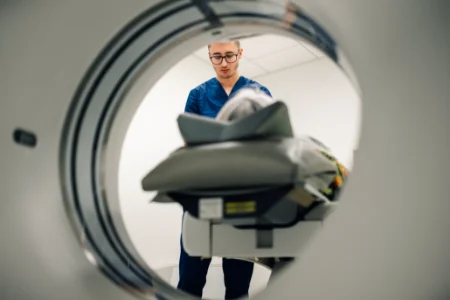
CT coronary angiography — commonly known as CTCA — is a non-invasive imaging test that provides detailed pictures of the coronary arteries, the blood vessels that supply your heart muscle. It is one of the most accurate non-invasive methods available for detecting coronary artery disease, including narrowing, blockages, and plaque build-up that may not yet be causing symptoms.
SmartCare Diagnostics performs CTCA at our Springfield clinic. For eligible patients referred by a specialist, CTCA is bulk billed under Medicare.
What Does a CTCA Show?
CTCA uses a CT scanner combined with an intravenous contrast agent to create highly detailed images of the coronary arteries. Unlike invasive coronary angiography — which requires a catheter to be inserted into an artery — CTCA is performed externally using a CT scanner. There is no hospital admission and no arterial puncture.
The scan can reveal:
- The presence, location, and severity of coronary artery plaque — including both calcified and soft plaque
- The degree of narrowing (stenosis) in the coronary arteries
- Whether bypass grafts from previous cardiac surgery remain patent
- Other structural findings that may explain symptoms such as chest pain
CTCA is particularly valuable because it can detect early-stage coronary artery disease — including soft plaque — before it causes symptoms or progresses to a cardiac event. This makes it an important tool for both diagnosis and prevention.
When Does Your Doctor Refer You for a CTCA?
Your GP or cardiologist may refer you for a CTCA for a range of clinical reasons. The most common indications include:
- Chest pain assessment — particularly in patients with low to intermediate risk of coronary artery disease, where CTCA is recommended as a first-line diagnostic test by international guidelines
- Unexplained shortness of breath — where a cardiac cause needs to be investigated
- Cardiac risk stratification — in patients with risk factors such as high blood pressure, diabetes, high cholesterol, smoking history, or a strong family history of premature heart disease
- Follow-up after coronary artery bypass surgery — to assess whether grafts remain open and functional
- Pre-operative cardiac assessment — where non-invasive imaging is preferred before a planned surgery
- Asymptomatic patients with strong family history — where early detection of coronary plaque may guide preventive treatment
Current international guidelines support CTCA as a first-line diagnostic test for patients presenting with stable chest pain who are at low to intermediate risk of coronary artery disease. It offers advantages over traditional stress testing in its ability to directly visualise coronary anatomy and detect early plaque.
CTCA vs Invasive Coronary Angiography
Invasive coronary angiography — where a catheter is inserted through an artery to image the coronary vessels — remains the gold standard for diagnosing coronary artery disease. However, it is an invasive procedure that requires hospital admission and carries procedural risks.
CTCA provides a non-invasive alternative that is highly accurate for ruling out significant coronary artery disease. Studies report accuracy of approximately 96 per cent for detecting coronary artery disease. CTCA has the highest negative predictive value of all non-invasive cardiac tests — meaning that if a CTCA is normal, the likelihood of significant coronary artery disease is very low.
Where CTCA identifies severe coronary artery disease, your referring doctor may then recommend invasive angiography for further assessment and potential intervention such as stenting.
CTCA vs Stress Testing
Traditional stress testing — including exercise stress ECG and stress echocardiography — evaluates how the heart functions under physical stress. These are functional tests that detect the consequences of reduced blood flow, such as abnormal heart muscle movement.
CTCA is an anatomical test. It directly images the coronary arteries and identifies the presence and extent of plaque, regardless of whether that plaque is currently causing symptoms. This means CTCA can detect disease at an earlier stage than stress testing alone.
Your referring doctor will determine which test is most appropriate based on your symptoms, risk factors, and clinical history. In some cases, both CTCA and stress testing may be recommended.
CT Coronary Calcium Score
A CT coronary calcium score is a separate, non-contrast scan that measures the amount of calcified plaque in the coronary arteries. It provides a numerical score that correlates with overall coronary artery disease burden.
A calcium score is often performed as an initial screening tool. Where the calcium score indicates significant calcification, a full CTCA may be recommended to assess the severity and location of disease in greater detail.
SmartCare Diagnostics offers both CT coronary calcium scoring and full CTCA at our Springfield clinic.
What to Expect Before Your CTCA
Preparation for a CTCA typically includes:
- Avoid caffeine for at least 24 hours before the scan — including tea, coffee, chocolate, and caffeinated soft drinks
- Continue all usual medications unless your referring doctor advises otherwise
- A low and steady heart rate is important for image quality — your doctor may prescribe a beta-blocker to take before the appointment
- Bring a list of your current medications and any previous cardiac test results
- Allow approximately 1 to 2 hours for the full appointment, including preparation, scanning, and observation
What Happens During the Scan
When you arrive, the radiographer will check your blood pressure and heart rate. ECG electrodes will be attached to your chest. If your heart rate requires further reduction, medication may be administered.
An intravenous cannula will be placed in your arm for the contrast injection. You will lie on the CT scanner table and may be given a sublingual spray (GTN) to dilate the coronary arteries for clearer imaging.
During the scan, contrast is injected through the cannula. You may feel a brief warm sensation or a metallic taste — this is normal and passes within seconds. You will be asked to hold your breath for approximately 10 to 15 seconds while the images are captured.
The scan itself takes only a few minutes. After the scan, you will be observed briefly before being discharged.
After the Scan
Most patients can resume normal activities immediately. The images are reviewed by a specialist radiologist or cardiologist, and a detailed report is sent to your referring doctor. Turnaround is typically within 24 to 48 hours.
Your referring doctor will discuss the results with you and advise on any follow-up, further testing, or treatment that may be needed.
Referral and Billing
A valid referral is required for CTCA. Medicare bulk billing applies to eligible specialist referrals — meaning if your cardiologist or other specialist refers you, there is no out-of-pocket cost for eligible Medicare cardholders.
GP referrals for CTCA may attract an out-of-pocket fee. Your GP may choose to refer you to a cardiologist first, who can then request the CTCA under Medicare if clinically indicated. SmartCare Diagnostics will advise you of any costs before your appointment.
Frequently Asked Questions
To book a CTCA or refer a patient, contact SmartCare Diagnostics on [email protected] or visit smartcd.com.au. CTCA is available at our Springfield clinic.
Other questions? CONTACT OUR TEAM
Ready to book in? BOOK YOUR CTCA
*This article is for general information and educational purposes only. It is not a substitute for professional medical advice, diagnosis or treatment. Always follow the guidance of your GP, specialist or other qualified health professional regarding any questions about your health. Please call triple zero (000) immediately if you believe your symptoms are life-threatening.
Accessible diagnostic testing. Bulk billed for eligible Medicare cardholders.